
Advantages of Blood Tests
Traditional Biomarker Assessments for Brain Amyloid Pathology Face Barriers and Drawbacks


Amyloid PET imaging quantifies the density and distribution of amyloid plaques in the brain.1-3
Amyloid PET Imaging Drawbacks2-5
- Cost and accessibility
- Exposure to radiation
- Does not dynamically capture biomarker production or clearance
- Clinical value dependent on image quality and interpretation
- PET tracer adverse reactions

CSF analysis measures soluble biomarkers of AD pathology in the cerebrospinal fluid.2,3
CSF Analysis Drawbacks2,3
- Contraindicated in patients taking anticoagulants
- Complicated spinal anatomy
- Does not directly measure accumulated biomarker load
- Invasive and patient hesitancies
Blood Tests Can Improve Access and Provide Highly Accurate Insights
Advantages and Disadvantages of Available High-Performing Amyloid Pathology Assessment Tests to Assist in Making an AD Diagnosis
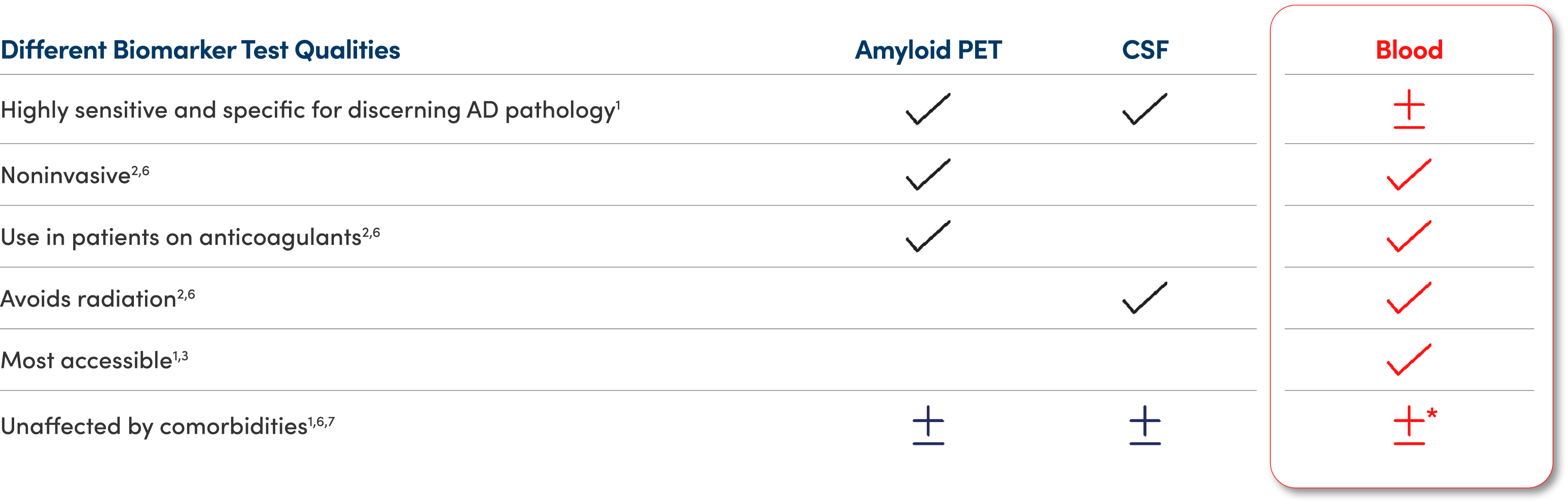
+/- indicates variability between the tests in this category.
While blood tests can assist in making an early AD diagnosis, some may be limited by their ability to discern AD pathology and could be affected by comorbidities.1,3,8
Multiple Recommendations and Guidelines Support High-Performing Blood Tests to Confirm AD Pathology
“For use as a confirmatory test without follow-up tests, a blood biomarker test should have performance equivalent to that of CSF tests—a sensitivity and specificity of ~90%.”1
— Global CEOi Blood Biomarker Tests Workgroup Consensus Statement, 2024
“Thus, our definition of Core 1 plasma tests that suffice as standalone diagnostic tests for AD is those with a minimum accuracy of 90% to detect abnormal amyloid PET in the intended-use population, or, more simply, plasma tests whose diagnostic performance is equivalent to that of approved CSF assays.”3
— Alzheimer’s Association Workgroup Statement, 2024
“Blood biomarker tests with ≥90% sensitivity and specificity can serve as a substitute for amyloid PET imaging or CSF AD biomarker testing in patients with cognitive impairment presenting to specialized care for memory disorders.”8
— Alzheimer’s Association Clinical Practice Guidelines on the Use of Blood Biomarker Tests in the Diagnostic Workup of Suspected AD Within Specialized Care Settings, 2025
Not All Blood Tests Undergo the Same Rigorous Clinical Validation
- Demographic characteristics of the study cohort do not always match the intended-use population1
- Inaccurate estimates of disease prevalence could affect key performance metrics: Positive and negative predictive values1
- Cohorts studied outside of specialty care settings or that include cognitively unimpaired individuals can skew study results8
In addition, tests with poorer performance typically have higher variability in measurements, increasing the proportion of tests that result in indeterminant values.1
Not all validation studies are equal in their design and outcomes.
Measuring 2 Biomarker Ratios, %p-tau217 and Aβ42/40, Reduces Interference From Non-AD Factors, Allowing for More Reliable Test Results
Measuring %p-tau217 and Aβ42/40 can enhance test performance and help account for variabilities caused by comorbidities or other factors, which may affect tests that measure individual biomarkers.9-17
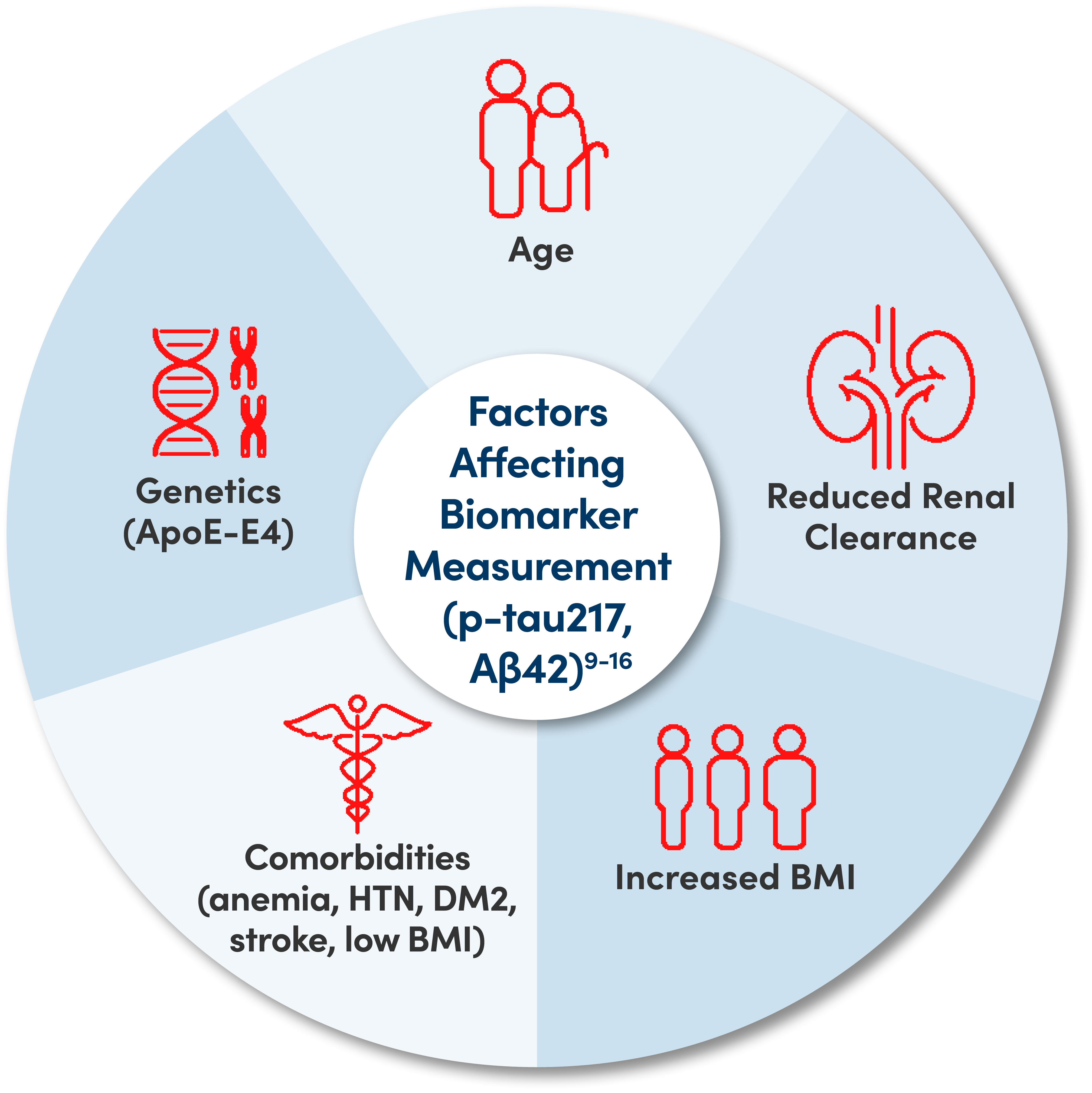
Comorbidities and other factors drive different changes in p-tau217 and Aβ42 biomarkers9-16
- Age: Advanced age can ↑ Aβ42
- Genetics: ApoE-ε4 can be associated with ↑ Aβ42
- Comorbidities: Anemia, HTN, DM2, stroke, and low BMI can all drive ↑ p-tau217, Aβ42
- Renal Clearance: Impaired renal function can ↑ p-tau217
- BMI: Obesity can lead to ↓ p-tau217, Aβ42
A blood test assessing %p-tau217 and Aβ42/40—rather than single analyte concentration—can improve test efficacy while controlling for patient variability.
Using Blood Tests to Aid in Diagnosing AD Can Help Inform Timely, Individualized Care Across the AD Continuum
To educate patients and their care partners on the benefits of an early AD diagnosis, it’s important to communicate how a high-performing AD blood test can...

Rule in or rule out AD pathology, enabling a patient to have clearer insights into their clinical condition1,3

Inform treatment and management decisions, including consideration of symptomatic treatments18

Help determine eligibility for DMT; treatment can potentially slow the progression of AD18

Provide information to help patients and families connect to resources and plan for the future, regardless of where they are in the AD clinical continuum18
Engaging in shared decision-making with patients, care partners, and caregivers aligns their values and goals to effectively plan for the future when considering if an AD blood test is right for them.1,8
Two-Cutoff Blood Tests Can Help to Better Empower Clinicians in Their Clinical Decision-Making


Test Features1,3,8
- Binary results readout
- Simpler for laboratories to monitor performance
- Increased potential for false positives/negatives
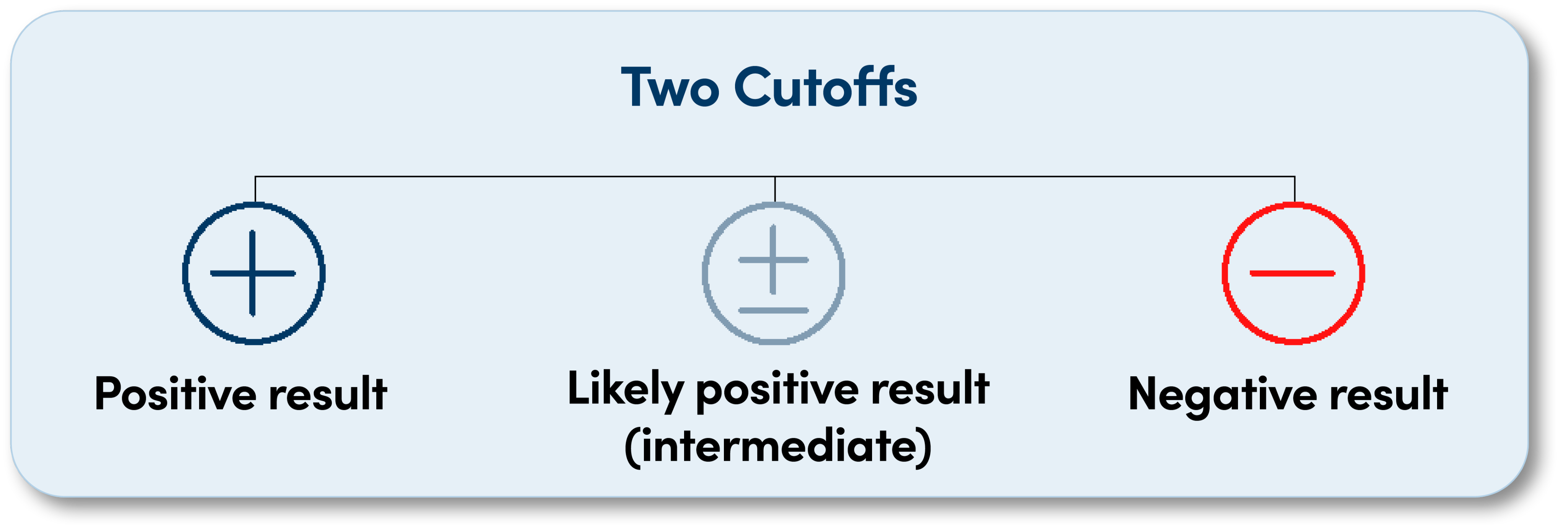
Test Features1,3
- Increases the accuracy of positive and negative results, and gives patients more confidence in results
- Aligned with real-world decision-making
- Results in the middle category invite further HCP interpretation
Some two-cutoff tests using a "likely positive" category can provide interpretable insights that inform next steps for patients.19
1. Schindler SE, Galasko D, Pereira AC, et al. Acceptable performance of blood biomarker tests of amyloid pathology - recommendations from the Global CEO Initiative on Alzheimer’s disease. Nat Rev Neurol. 2024;20(7):426-439. doi:10.1038/s41582-024-00977-5. 2. Porsteinsson AP, Isaacson RS, Knox S, Sabbagh MN, Rubino I. Diagnosis of early Alzheimer’s disease: clinical practice in 2021. J Prev Alzheimers Dis. 2021;8(3):371-386. doi:10.14283/jpad.2021.23 3. Jack CR, Andrews JS, Beach TG, et al. Alzheimers Dement. Revised criteria for diagnosis and staging of Alzheimer’s disease: Alzheimer’s Association workgroup. 2024;20(8):5143-5169. doi:10.1002/alz.13859. 4. NEURACEQ. Prescribing Information. Bedford, MA: Lantheus; 2025. 5. Rabinovici GD, Knopman DS, Arbizu J, et al. Updated appropriate use criteria for amyloid and tau PET: A report from the Alzheimer's Association and Society for Nuclear Medicine and Molecular Imaging Workgroup. Alzheimers Dement. 2025;21(1):e14338. doi:10.1002/alz.14338. 6. Mielke MM, Anderson M, Ashford JW, et al. Recommendations for clinical implementation of blood-based biomarkers for Alzheimer’s disease. Alzheimers Dement. 2024;20(11):8216-8224. doi:10.1002/alz.14184. 7. Leuzy A, Bollack A, Pellegrino D, et al. Considerations in the clinical use of amyloid PET and CSF biomarkers for Alzheimer’s disease. Alzheimers Dement. 2025;21(3):e14528. doi:10.1002/alz.14528. 8. Palmqvist S, Whitson HE, Allen LA, et al. Alzheimer’s Association clinical practice guideline on the use of blood-based biomarkers in the diagnostic workup of suspected Alzheimer’s disease within specialized care settings. Alzheimers Dement. 2025;21(7):e70535. doi:10.1002/alz.70535. 9. Karlsson L, Janelidze S, Barthélemy NR, et al. Reference proteins to improve Core 1 and Core 2 Alzheimer’s disease CSF and plasma biomarkers. Brain. Published online October 6, 2025. doi:10.1093/brain/awaf375. 10. Yun J, Lee J, Shin D, et al. Plasma Phosphorylated Tau 217 Cutoffs for Amyloid Pathology and Kidney Function, Body Mass Index, and Anemia. JAMA Neurol. Published online February 2, 2026. doi:10.1001/jamaneurol.2025.5530. 11. Warmenhoven N, Salvadó G, Janelidze S, et al. A comprehensive head-to-head comparison of key plasma phosphorylated tau 217 biomarker tests. Brain. 2025;148(2):416-431. doi:10.1093/brain/awae346. 12. Syrjanen A, Campbell MR, Algeciras-Schimnich A, et al. Associations of amyloid and neurodegeneration plasma biomarkers with comorbidities. Alzheimers Dement. 2022;18(6):1128-1140. doi:10.1002/alz.12466. 13. Binette AP, Janelidze S, Cullen N, et al. Confounding factors of Alzheimer’s disease plasma biomarkers and their impact on clinical performance. Alzheimers Dement. 2023;19(4):1403-1414. doi:10.1002/alz.12787. 14. Schindler SE, Karikari TK, Ashton NJ, et al. Effect of race on prediction of brain amyloidosis by plasma Aβ42/Aβ40, phosphorylated tau, and neurofilament light. Neurology. 2022;99(3):e245-e257. doi:10.1212/WNL.0000000000200358. 15. Janelidze S, Bali D, Ashton NJ, et al. Head-to-head comparison of 10 plasma phospho-tau assays in prodromal Alzheimer’s disease. Brain. 2023;146(4):1592-1601. doi:10.1093/brain/awac333. 16. Lue LF, Kuo YM, Roher AE, et al. Soluble amyloid beta peptide concentration as a predictor of synaptic change in Alzheimer’s disease. Am J Pathol. 1999;155(3):853-862. doi:10.1016/s0002-9440(10)65184-x. 17. Mielke MM, Fowler NR. Alzheimer disease blood biomarkers: considerations for population-level use. Nat Review Neurol. 2024;20(8):495-504. doi:10.1038/s41582-024-00989-1. 18. Alzheimer’s Association. 2026 Alzheimer’s disease facts and figures. Alzheimers Dement. 2026;22. https://doi.org/10.1002/alz.71345. 19. PrecivityAD2 [package insert]. St. Louis, MO: C2N Diagnostics; 2026.