
About the PrecivityAD2® Test
The PrecivityAD2® Test, C2N’s FDA-Cleared Blood Test to Assist With Ruling In or Out AD Pathology
Indications for ordering1
- Use in patients aged 40 and older who present with signs or symptoms of cognitive impairment undergoing evaluation for Alzheimer’s disease or other forms of cognitive decline
- Use in conjunction with clinical assessment to identify patients with amyloid pathology associated with Alzheimer’s disease
- The test is not intended as a screening or stand-alone diagnostic
The PrecivityAD2® test is indicated for adults 40 years and older with signs or symptoms of cognitive impairment. The test uses high-resolution mass spectrometry to measure Aβ42/40 and %p-tau217 and combines these biomarkers using a proprietary algorithm to calculate the Amyloid Probability Score 2 (APS2), which indicates the likelihood of brain amyloid pathology.
The PrecivityAD2® test demonstrated consistent, reliable diagnostic performance across the spectrum of cognitive impairment evaluated, with increasing age and 12 pre-specified chronic diseases commonly associated with aging to aid HCPs experienced with evaluating for AD.

The PrecivityAD2® Two-Cutoff Test Provides Three Categories of Results: Positive, Likely Positive, and Negative1
Most patients (82.7%) receive a highly accurate negative or positive test result.
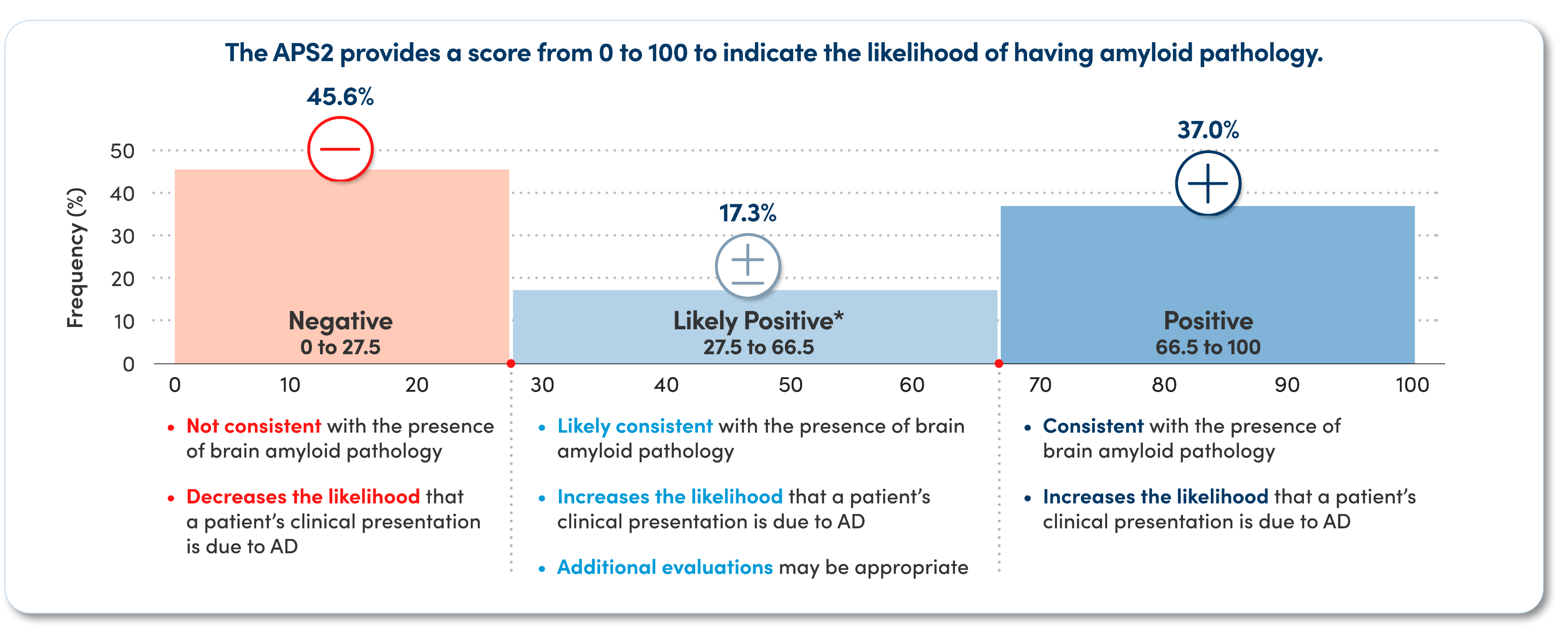
*Likely positive results have a higher statistical probability of having amyloid pathology than not having it: ~3 out of 4 likely positive participants had brain amyloid pathology.
The APS2 result alone does not establish a diagnosis of clinical Alzheimer’s disease. The test is not intended as a screening or stand-alone diagnostic test.
The PrecivityAD2® test builds upon the success and legacy of the single-cutoff APS2 to deliver accurate, stratified results using two cutoffs to help clinicians navigate the AD diagnostic journey.
The PrecivityAD2® Testing Platform Uses High-Resolution Mass Spectrometry (HRMS) Technology
Unique Advantages of C2N’s HRMS Testing Platform

Mass spectrometry has been established as a gold-standard method for protein identification2
HRMS directly identifies proteins based on a mass-to-charge ratio to quantify unique protein formations—a fingerprint for the molecule3
Direct quantification of low- and high-abundance AD biomarkers in the blood: p-tau217, np-tau217, Aβ42, and Aβ404,5
High concordance with amyloid PET imaging and CSF assays6
Flexibility in sample handling helps to optimize sample analytes3
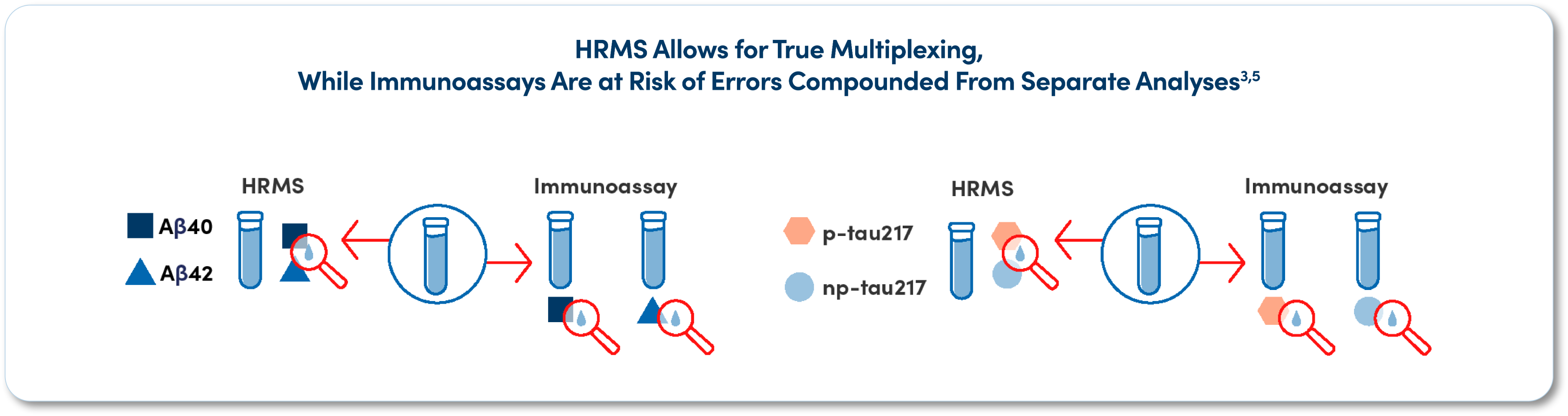
Multiplex enables these 4 biomarkers to be analyzed in fewer runs, an optimal feature for biomarker ratios4,5
Limitations and Warnings
Limitations
- The PrecivityAD2® test is for prescription use only
- The PrecivityAD2® test is for in vitro diagnostic use: only performed at C2N Diagnostics Laboratory
- This test is intended to be performed only on qualified, serial number-controlled instruments at C2N Diagnostics Laboratory. All instruments used for patient testing are controlled under C2N’s Quality Management System and must successfully complete the required qualification and validation activities before implementation
- Always interpret the PrecivityAD2® test in conjunction with the patient’s medical history, clinical presentation, physical assessment, and other findings
- The safety and effectiveness of the PrecivityAD2® test have not been established for:
- Predicting development of dementia or other neurologic conditions
- Monitoring responses to therapies
- The performance of the PrecivityAD2® test across racial subgroups has not been fully established because of the relatively small number of subjects who report racial categories other than White and the large proportion of subjects in the Pooled Validation Cohort with missing racial categorization. Results for these subgroups should be interpreted with caution
Warnings
- Erroneous results may occur due to improper specimen collection, handling, storage, shipping, or unevaluated interfering substances
- Hemoglobin concentration >150 mg/dL may interfere with analyte measurement and affect the APS2 result
1. PrecivityAD2 [package insert]. St. Louis, MO: C2N Diagnostics; 2026. 2. Bravo-Veyrat S, Hopfgartner G. Mass spectrometry based high-throughput bioanalysis of low molecular weight compounds: are we ready to support personalized medicine?. Anal Bioanal Chem. 2022;414(1):181-192. doi:10.1007/s00216-021-03583-2. 3. Wang Y, Bednarcik M, Ament C, et al. Immunoassays and mass spectrometry for determination of protein concentrations in genetically modified crops. J Agric Food Chem. 2024;72(16):8879-8889. doi:10.1021/acs.jafc.3c09188. 4. Kirmess KM, Meyer MR, Holubasch MS, et al. The PrecivityAD™ test: accurate and reliable LC-MS/MS assays for quantifying plasma amyloid beta 40 and 42 and apolipoprotein E proteotype for the assessment of brain amyloidosis. Clin Chim Acta. 2021;519:267-275. doi:10.1016/j.cca.2021.05.011. 5. Eastwood SM, Meyer MR, Kirmess KM, et al. PrecivityAD2™ Blood Test: Analytical Validation of an LC-MS/MS Assay for Quantifying Plasma Phospho-tau217 and Non-Phospho-tau217 Peptide Concentrations That Are Used with Plasma Amyloid-β42/40 in a Multianalyte Assay with Algorithmic Analysis for Detecting Brain Amyloid Pathology. Diagnostics. 2024;14(16):1739-1756. 6. Brand AL, Lawler PE, Bollinger JG, et al. The performance of plasma amyloid beta measurements in identifying amyloid plaques in Alzheimer’s disease: a literature review. Alzheimers Res Ther. 2022;14(1):195-209. doi:10.1186/s13195-022-01117-1.