
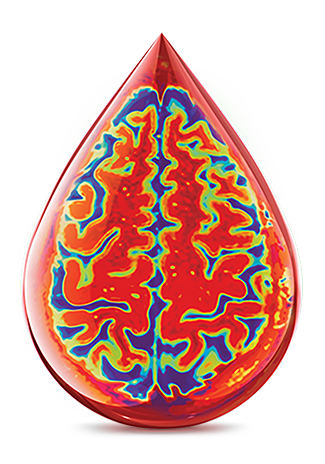
The PrecivityAD2® test is for patients aged 40 and older with signs or symptoms of cognitive impairment to help with an Alzheimer’s disease clinical evaluation.1
Testing early for Alzheimer’s disease can answer important questions about your brain health.2
When memory changes, early answers can make a difference.2
Talk to your doctor about a simple blood test that can help diagnose Alzheimer’s.1

Learn more about the Precivity® blood tests through the experience of a patient.

What is the PrecivityAD2® blood test?
The PrecivityAD2® blood test provides information related to changes that may be present in your brain that are associated with Alzheimer’s disease. Your doctor may use this and other medical information to help determine if Alzheimer’s disease is contributing to your memory changes to help develop a care plan for you.1,3

What does the PrecivityAD2® blood test look for?
This test looks for signs of amyloid plaques (a type of protein) in the brain, a key feature of Alzheimer’s disease. Knowing if you have amyloid plaques in your brain can help your doctor decide what types of treatments or resources might be a good fit for you.1
What are the 3 possible blood test results?
Negative: This result indicates a low likelihood that amyloid plaques are present in your brain. A negative result does not by itself determine the cause of your cognitive concerns. Your doctor will consider this result along with your symptoms, medical history, and other information to help determine the next steps.

Likely Positive: This result indicates that it is likely that amyloid plaques are present in your brain. A Likely Positive result does not by itself mean that you have Alzheimer's disease. In the clinical study, about 3 out of 4 people with a Likely Positive result had amyloid pathology. Your doctor will consider this result along with your symptoms, medical history, and other information to help determine the next steps.

Positive: This result indicates a high likelihood that amyloid plaques are present in your brain. A Positive result does not by itself mean that you have Alzheimer’s disease. Your doctor will consider this result along with your symptoms, medical history, and other information to help determine the next steps.

The PrecivityAD2® test was reviewed and cleared by the FDA, making it a test you and your doctor can trust.1

Concerned about your memory? Why getting answers early matters.
Knowing what may be causing memory changes sooner rather than later can help you and your doctor decide what to do next.2
Before taking any test, ask your doctor any and all questions you have and learn about the benefits of testing.
It's important you, your family, and loved ones feel comfortable with your doctor's approach to your health.
Questions to ask your doctor:
- What might be causing my memory changes?
- Is the PrecivityAD2® blood test right for me?
- What are the possible next steps?
The earlier you find out if Alzheimer's disease is causing your memory problems, the sooner your doctor can help you and your loved ones make informed healthcare choices.2
Take the next step.
If you’re concerned about memory changes, either for yourself or a loved one, talk with your doctor about whether the PrecivityAD2® blood test may be the right next step as part of an Alzheimer’s disease evaluation.
Financial Assistance
At C2N, our mission is to make Alzheimer's disease testing accessible for all patients, regardless of income level. For more information on financial assistance or billing questions, contact Client Services at 1-877-C2N-DIAG (226-3424) or billingservices@c2n.com.
Where to go for more information about the PrecivityAD2® test:
Your doctor is the best resource to learn more about whether the PrecivityAD2® test is right for you. This is because your doctor knows you and your medical information.
For more information about Alzheimer's disease:
1. PrecivityAD2 [package insert]. St. Louis, MO; C2N Diagnostics; 2026. 2. Alzheimer’s Association. 2026 Alzheimer’s disease facts and figures. Alzheimers Dement. 2026;22. https://doi.org/10.1002/alz.71345. 3. Monane M, Maraganore DM, Carlile RM, et al. Clinical utility of an Alzheimer’s disease blood test among cognitively impaired patients: results from the quality improvement PrecivityAD2 (QUIP II) clinician survey study. Diagnostics (Basel). 2025;15(2):167. doi:10.3390/diagnostics15020167.